United Launch Alliance Vulcan-Centaur
In 2014, United Launch Alliance (ULA) announced the development of a new space launch vehicle to replace their existing Delta 4 and Atlas V rockets. Both vehicles were too expensive compared to the new Falcon 9 from SpaceX, and the Atlas V faced the problem, that its main stage used a Russian RD-180 engine. After Russia's annexation of Crimea in 2014, further import of these engines and their use for military missions was banned.
The new rocket's core stage is named Vulcan, and uses two Blue Origin BE-4 engines burning liquid oxygen and liquid methane. The upper stage is a Centaur 5 with two Aerojet RL10C liquid-fueled (LOX/LH2) engines. Additionally, up to six Northrop Grumman GEM-63XL solid-rocket boosters can be strapped to the Vulcan core. For the payload, two fairing sizes are offered, a standard one of 15.5 m (51 ft) length, and a longer 21.3 m (70 ft) variant.
| Stage | Length | Diameter | Engine(s) | Fuel | Thrust |
|---|---|---|---|---|---|
| 0 | 21.9 m | 1.60 m | Northrop Grumman GEM-63XL | Solid | 2045 kN each |
| 1 | 33.3 m | 5.4 m | 2 Blue Origin BE-4 | LOX/methane | 2447 kN each |
| 2 | 11.7 m | 5.4 m | 2 Aerojet RL10C | LOX/LH2 | 107 kN each |
Specifications for Vulcan-Centaur stages
The configurations of the Vulcan-Centaur are designated VCnS (standard payload fairing) and VCnL (long payload fairing), with n being the number of strap-on boosters (0, 2, 4 or 6). After some delays, the first Vulcan-Centaur lifted off on 8 January 2024, in the VC2S configuration. After another VC2S launch in 2024, the next two flights, on 13 August 2025 and 12 February 2026, were of VC4S configuration and launched U.S. Space Force satellites into orbit. At the time of this writing, ULA has contracts for about 25 further Vulcan-Centaur launches for the USSF and the NRO. Upcoming commercial Vulcan-Centaur launches are booked by Amazon for their Amazon-LEO mega-constellation.
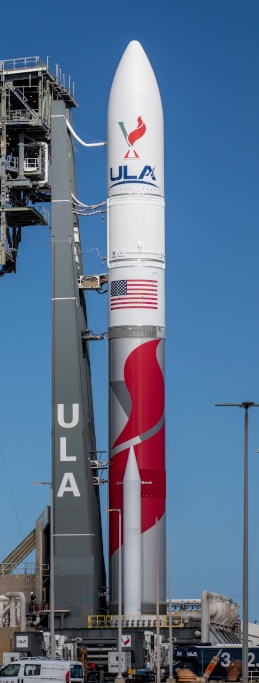 |
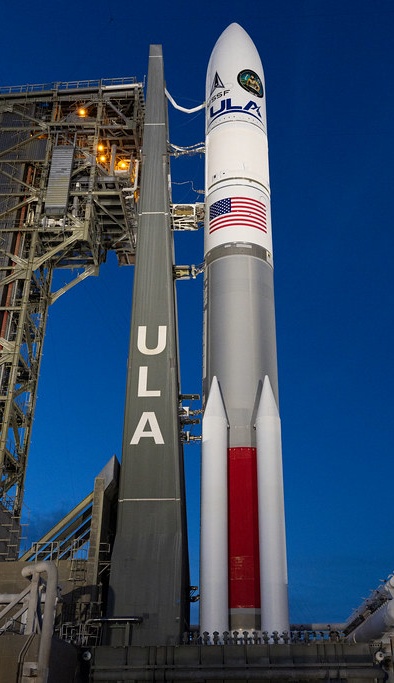 | |
| Photo: NASA/Ben Smegelsky | Photo: ULA | |
| Vulcan-Centaur VC2S | Vulcan-Centaur VC4S |
Planned upgrades of the Vulcan-Centaur include a Centaur 5+ upper stage with slightly improved RL10E engines, and a method to reuse the core's BE-4 engines by a heat-shield/parachute assisted recovery.
Specifications
Note: Data given by several sources show slight variations. Figures given below may therefore be inaccurate!
Data for Vulcan-Centaur:
| Length | VCnS: 61.6 m (202 ft) VCnL: 67.4 m (221 ft) |
| Diameter | 5.4 m (17.7 ft) |
| Weight | max at lift-off: 547 t (1205000 lb) |
| Payload to LEO | VC0S: 10800 kg (23800 lb) VC2S: 19000 kg (41900 lb) VC4S: 24600 kg (54200 lb) VC6S: 27200 kg (60000 lb) |
| Payload to GTO | VC0S: 3500 kg (7700 lb) VC2S: 8400 kg (18500 lb) VC4S: 11700 kg (25800 lb) VC6S: 14500 kg (32000 lb) |
| Propulsion |
Booster (VCnS/L): n GEM-63XL solid-fueled rocket; 2045 kN (459600 lb) max each 1st stage: 2 BE-4 liquid-fueled rockets; 4895 kN (1100000 lb) at lift-off 2nd stage: 2 RL10C liquid-fueled rockets; 214 kN (48000 lb) |
Main Sources
[1] ULA Website: Vulcan
[2] Michael H. Gorn, Giuseppe de Chiara, Davide Sivolella: "The Complete Book of Spacecraft", 2nd ed., Motorbooks, 2025
[3] Gunter Krebs: Gunter's Space Page (for launch lists)
Back to Directory of U.S. Military Rockets and Missiles, Appendix 3
Last Updated: 22 February 2026