Northrop Grumman (Orbital Sciences) Antares
The Antares launch vehicle, originally named Taurus 2, was developed by Orbital Sciences Corp. specifically for NASA's ISS resupply missions. It is a 2-stage rocket, which can optionally be equipped with a 3rd stage for higher or more flexible orbital insertions. Antares configurations are designated by a 3-digit number, which indicates the used stages:
| First digit | Stage 1 engines | Fuel | Thrust |
|---|---|---|---|
| 1 | 2 Aerojet AJ26-62 | Lox/kerosene | 3265 kN |
| 2 | 2 NPO Energomash RD-181 | Lox/kerosene | 3845 kN |
| 3 | 7 Firefly Miranda | Lox/kerosene | 7200 kN |
| Second digit | Stage 2 engine | Fuel | Thrust |
|---|---|---|---|
| 1 | 1 Northrop Grumman (Thiokol) Castor 30A | Lox/kerosene | 259 kN |
| 2 | 1 Northrop Grumman (Thiokol) Castor 30B | Lox/kerosene | 293.4 kN |
| 3 | 1 Northrop Grumman (Thiokol) Castor 30XL | Lox/kerosene | 474 kN |
| Third digit | Stage 3 | Fuel | Thrust |
|---|---|---|---|
| 0 | (None) | ||
| 1 | BTS (Bi-Propellant Third Stage) | N2O4/Hydrazine | |
| 2 | Northrop Grumman (Thiokol) Star 48BV | Solid | |
| 3 | Northrop Grumman (Hercules/ATK) Orion 38 | Solid | |
Antares Configuration Designation Digits
The initial Aerojet AJ26-62 first-stage engines were actually refurbished Russian Kuznetsov NK-33 liquid-fueled engines. They were used for the first five Antares flights, the first of which, in Antares 110 configuration, occurred on 21 April 2013. But the fifth flight, an Antares 130 on 28 October 2014, ended in a catastrophic failure, when the rocket exploded shortly after lift-off. The investigation showed, that the likely cause were manufacturing quality issues in the refurbished NK-33s, and Orbital subsequently switched to new-built Russian NPO Energomash RD-181 engines. Between 27 October 2016 and 17 April 2019, five Antares 230 rockets were flown. The remaining eight launches until the final one on 2 August 2023 used the Antares 230+, which had some structural improvements. All Antares missions launched Northrop Grumman (Orbital Sciences) Cygnus cargo delivery vehicles to the ISS. None of the flights used a third stage.
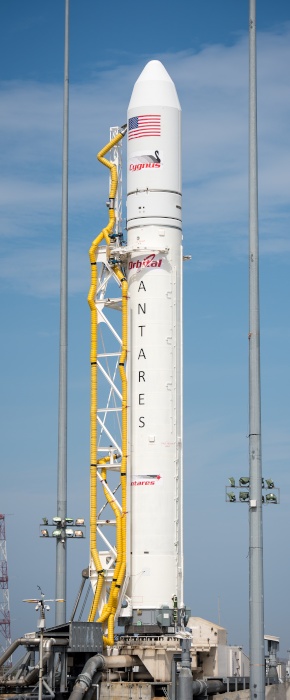 |
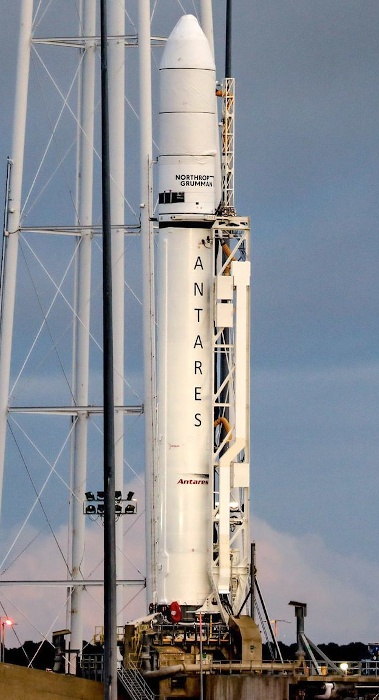 | |
| Photo: NASA/Bill Ingalls | Photo: NASA/Terry Zaperach | |
| Antares 110 | Antares 230+ |
Since 2018, prime contractor for Antares is Northrop Grumman, which had acquired Orbital ATK (merger of Orbital Sciences and Alliant Techsystems) in that year. At that time, it was already clear that no additional RD-181 engines could be purchased because of bans to import Russian rocket engines. By 2022, Northrop Grumman had selected Firefly Aerospace to build a new first stage, using 7 of their Miranda liquid-fueled engines. At the time of this writing, the Antares 330 has not yet flown.
Specifications
Note: Data given by several sources show slight variations. Figures given below may therefore be inaccurate!
Data for Antares 230/230+:
| Length | 42.5 m (139 ft) |
| Diameter | 3.9 m (13 ft) |
| Weight | max at lift-off: 298 t (657000 lb) |
| Payload to LEO | 8000 kg (18000 lb) |
| Propulsion |
1st stage: 2 RD-181 liquid-fueled rockets; 3845 kN (864000 lb) at lift-off 2nd stage: 1 Castor 30XL liquid-fueled rocket; 474 kN (107000 lb) |
Main Sources
[1] Northrop Grumman Website: Antares Rocket
[2] Michael H. Gorn, Giuseppe de Chiara, Davide Sivolella: "The Complete Book of Spacecraft", 2nd ed., Motorbooks, 2025
[3] Gunter Krebs, Gunter's Space Page: Antares (Taurus 2)
Back to Directory of U.S. Military Rockets and Missiles, Appendix 3
Last Updated: 22 February 2026