Air-Launched 2.75-Inch Rockets
Unguided air-launched rockets of 2.75 in (70 mm) diameter were originally developed in the late 1940s by the NOTS (Naval Ordnance Test Station) at China Lake. The rockets were to be used as more powerful supplements and/or replacements for guns in both air-to-air and air-to-ground applications. Many millions of rocket rounds have been built so far, and the latest versions, upgraded with guidance kits, are still widely used by all U.S. armed services.
MK 4 Mighty Mouse FFAR (Folding-Fin Aircraft Rocket), MK 40
The 2.75-inch FFAR (Folding-Fin Aircraft Rocket) was originally developed by the NOTS as an air-to-air weapon to be used by interceptors against heavy bombers. A salvo of rockets was considered much more effective than a stream of cannon shells. The rocket was spin-stabilized and featured four flip-out fins around the nozzle. Fitted with a 2.7 kg (6 lb) HE warhead, it was widely used in the 1950s as the Mighty Mouse air-to-air rocket by USAF interceptors like the F-86D Sabre, F-89J Scorpion, F-94C Starfire and F-102A Delta Dagger. Total length of the Mighty Mouse was 1.2 m (4 ft), and it weighed 8.4 kg (18.5 lb). Maximum range was around 6000 m (6500 yds), but effective range was more like 3400 m (3700 yds). The rocket's accuracy was relatively poor, because its speed and spin rate were too low to effectively counter gravity drop, cross winds and dispersion.
Complete Mighty Mouse rounds were initially designated with the following 2.75" Aircraft Rocket MARK/MOD numbers:
| Designation | Type | 2.75" Motor | 2.75" Head |
|---|---|---|---|
| MK 1 MOD 0 | Practice | MK 1 MOD 0 | MK 1 MOD 0 |
| MK 1 MOD 1 | Practice | MK 1 MOD 1 | MK 1 MOD 0 |
| MK 2 MOD 0 | HE | MK 1 MOD 3/4 | MK 1 MOD 1/3/4/5 |
| MK 2 MOD 1 | HE | MK 1 MOD 3/4 | MK 1 MOD 1/3/4/5 |
| MK 3 MOD 0 | HEAT | MK 1 MOD 3/4 | MK 5 MOD 0 |
| MK 4 MOD 0 | HE | MK 2 MOD 0/1/2/3 | MK 1 MOD 1/3/4/5 |
| MK 4 MOD 1 | HE | MK 2 MOD 0/1/2/3 | MK 1 MOD 1/3/4/5 |
| MK 5 MOD 0 | HEAT | MK 2 MOD 0/1/2/3 | MK 5 MOD 0 |
| MK 6 MOD 0 | HE | MK 3 MOD 0/1/2/3 | MK 1 MOD 1/3/4/5 |
| MK 6 MOD 1 | HE | MK 3 MOD 0/1/2/3 | MK 1 MOD 1/3/4/5 |
| MK 7 MOD 0 | HEAT | MK 3 MOD 0/1/2/3 | MK 5 MOD 0 |
| MK 8 MOD 0 | Practice | MK 2 MOD 0/1/2/3 | MK 1 MOD 1/3/4/5 |
| MK 9 MOD 0 | Practice | MK 3 MOD 0/1/2/3 | MK 1 MOD 1/3/4/5 |
By 1960, the new 2.75" Rocket Motor MK 4 (variants from MOD 0 to at least MOD 7) had been introduced, which could be used with all available 2.75" rocket heads. At the same time, the practice of allocating MARK/MOD designations to all-up rocket rounds was abandoned. Instead, the rocket type is generally identified by the designation of the motor assembly, which is the main body of the rocket and includes nozzle and fins. The various warheads are typically usable with all available motors, and are presumably often fitted to the rockets in the field only shortly before actual use. Therefore it was apparently deemed unnecessary to assign designations to every specific combination of rocket and payload. In fact, the original edition of the current designation system for rockets and missiles explicitly excluded unguided line-of-sight rockets from the system.
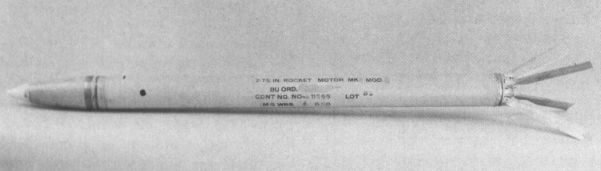 |
| Photo: via Ordway/Wakeford |
| Mighty Mouse MK 4 |
The 2.75-inch rocket was soon adapted for air-to-ground use, and a variety of warheads were developed. These included the heavier M151 and M229 HE fragmentation, the WDU-4/A flechette, and various smoke warheads for target spot marking and/or incendiary effects (for a list of 2.75-inch rocket warheads, see table in MK 66 section below). The 2.75-inch rocket was also adopted by the U.S. Army and Marine Corps as a primary weapon for its armed helicopters. For better performance when launched from these slow platforms, the MK 40 motor was developed. It has a modified nozzle for a greater spin and therefore higher accuracy.
Except for the specialized installations in early high-speed interceptors, the MK 4 and MK 40 rockets were almost exclusively employed from multi-tube launch pods. A wide variety of these pods were used, and the most important were:
- LAU-3/A: 19-tube launcher
- LAU-32/A: 7-tube launcher
- LAU-59/A: 7-tube launcher
- LAU-60/A: 19-tube launcher
- LAU-61/A: 19-tube launcher
- LAU-68/A: 7-tube launcher
- LAU-69/A: 19-tube launcher
- M158: 7-tube launcher; M158A1 was identical to LAU-68/A
- M159: 19-tube launcher; M159A1 was identical to LAU-61/A
- M200: 19-tube launcher; M200A1 was identical to LAU-69/A
The LAU-series was generally used by the fixed-wing aircraft of the Air Force and Navy, while the M-series launchers were used by the Army's helicopters. Most (possibly all) of these pods could be used with either the MK 4 or the MK 40 rockets.
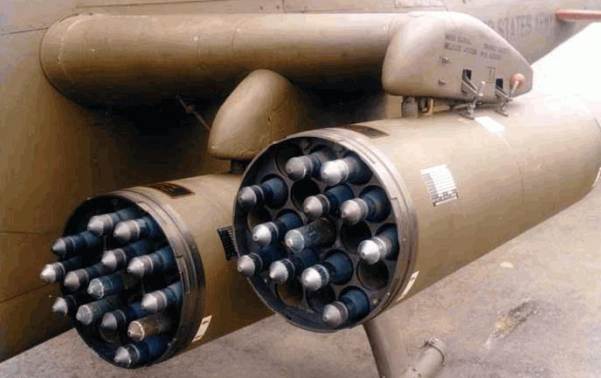 |
| Photo: U.S. Army |
| M200 rocket pod |
General Dymanics (Lockheed Martin, BEI Defense) MK 66 Hydra 70
The current 2.75-inch (70 mm) rockets are known as Hydra 70 rocket system, and use the MK 66 rocket motor. The latter was developed by the U.S. Army as a common replacement of the MK 4 and MK 40 for both fixed-wing aircraft and helicopters. The MK 66 is longer than the MK 4/40, uses an improved smoke-less propellant and has a completely new fin and nozzle assembly. The three fins are of the wrap-around type, and fit around the circumference of the rocket nozzle. Therefore the MK 66 is sometimes called a WAFAR (Wrap-Around Fin Aerial Rocket) instead of an FFAR. The MK 66 has a higher thrust and spin rate than the MK 4/40, increasing effective range and accuracy. The original MK 66 MOD 0 version was ready in 1972, but was not mass-produced. The first production versions were the MK 66 MOD 1 for the U.S. Army and the later MK 66 MOD 2 for the U.S. Air Force and Navy. The MOD 2 (development and full-rate production beginning in 1981 and January 1986, respectively) made the motor HERO (Hazards of Electromagnetic Radiation to Ordnance) safe. HERO safety prevents accidental ignition of the motor by stray electromagnetic fields like those emitted by a radar. The MK 66 MOD 3 is a HERO safe version of the MOD 1 for the Army. Development of the MK 66 MOD 4, to be used by all armed services, began in 1991. It entered full-scale production in December 1999, and became the standard motor for U.S. air-launched 70 mm rockets. It has internal changes, including new initiator and igniter, for further enhanced HERO safety. The MK 66 MOD 5 variant introduced measures for propellant venting during fast cook off, but it was not produced in quantity. A problem of the MK 66 motor is secondary combustion of exhaust gases, which lead to firing restriction on the AH-64 Apache helicopter to prevent engine surges. The MK 66 MOD 6 motor incorporates internal changes which greatly reduce this problem.
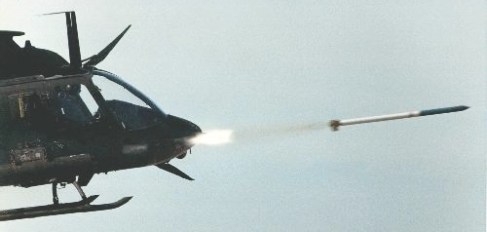 |
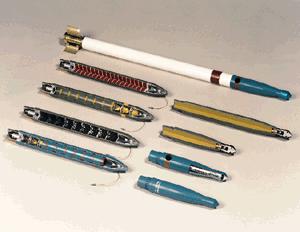 | |
| Photo: U.S. Army | Photo: General Dynamics | |
| Hydra 70 rocket | Hydra 70 system |
MK 66 rockets are typically used with the following launchers:
- LAU-61G/A: 19-tube launcher
- LAU-68D/A: 7-tube launcher
- LAU-130/A: 19-tube launcher
- LAU-131/A: 7-tube launcher
- M260: 7-tube light-weight launcher
- M261: 19-tube light-weight launcher
The original production of the MK 66 rockets was done by BEI Defense. In the mid-1990s, a follow-on production contract was awarded to Lockheed Martin Ordnance Systems, which was sold to General Dynamics in 1999. Current prime contractor for the Hydra 70 rocket system is GD's Armament and Technical Products division.
The current standard U.S. Navy launchers for MK 66 rockets are the LAU-61C/A 19-round and LAU-68D/A 7-round pods. All earlier versions (up to LAU-61B/A and -68C/A) could be used only with the older MK 4/MK 40 motors. Both launchers are thermally protected and support single and ripple mode firing. The USAF's pods for the MK 66 are the 7-round LAU-131/A and 19-round LAU-130/A, and the U.S. Army's current 70 mm LWLs (Light Weight Launchers) are the M260 (7-round) and M261 (19-round). All other 2.75" rocket pods are effectively no longer in use, presumably because they are not compatible with the MK 66 motor.
 |
| Photo: U.S. Army |
| Hydra 70 system |
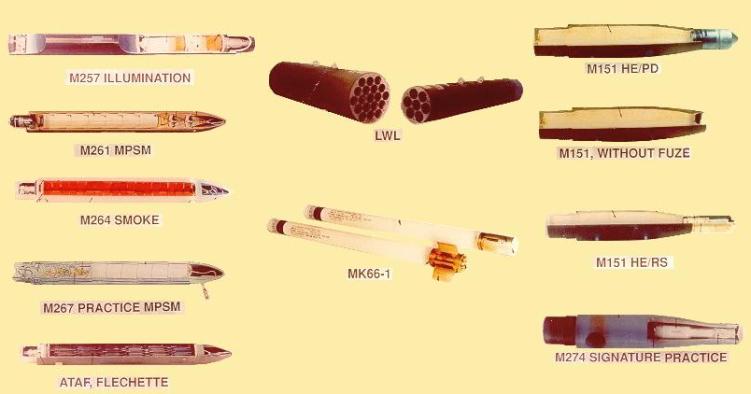
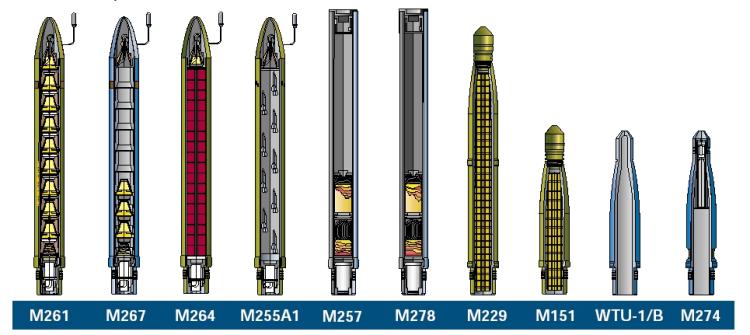
A wide selection of warheads, most of which were originally developed for the MK 4/40 FFARs, is available for the MK 66 Hydra 70 rocket. These include:
- M151: 3.95 kg (8.7 lb) anti-personnel blast/fragmentation warhead
- M156: White phosphorus smoke warhead
- M229: 7.3 kg (16.1 lb) anti-personnel blast/fragmentation warhead (elongated version of M151)
- M247: Shaped-charge anti-armour warhead
- M255: Flechette warhead; contains about 2500 28-grain (1.8 g) flechettes (M255E1 has 1180 60-grain (3.8 g) flechettes)
- M257: Parachute-retarded battlefield illumination flare
- M259: White Phosphorus smoke warhead
- M261: High-explosive MPSM (Multipurpose Submunition) warhead; contains nine M73 anti-personnel/anti-materiel bomblets, which are released in mid-air, and drag-retarded to fall vertically to the ground
- M264: Red phosphorus smoke warhead
- M267: Practice warhead for M261; contains three M75 practice submunitions
- M274: Practice warhead for M151; contains a smoke signature charge
- M278: Parachute-retarded infrared illumination flare
- M282: Multi-purpose Penetrator warhead
- MK 67 MOD 0: White phosphorus smoke warhead
- MK 67 MOD 1: Red phosphorus smoke warhead
- MK 149: Flechette warhead
- MK 152: 4.5 kg (10 lb) high-explosive warhead
- WDU-4A/A: Flechette warhead; contains about 2200 20-grain (1.3 g) flechettes
- WTU-1/B: Inert practice warhead
 |
| Drawing: General Dynamics |
| Hydra 70 warheads |
The following table lists the basic characteristics (length, weight) of Hydra 70 rockets with the warhead/fuze combinations currently used by the U.S. Navy:
| Warhead | Warhead Type | Fuze Options | Length | Weight |
|---|---|---|---|---|
| M151 | Anti-Personnel | M423, M427, MK 352 | 138.2 cm (54.39 in) | 10.4 kg (22.95 lb) |
| M156 | Smoke (White Phosphorus) | M423, M427, MK 352 | 140.0 cm (55.13 in) | 10.5 kg (23.25 lb) |
| M257 | Illumination (visible) | M442 | 186.1 cm (73.25 in) | 11.1 kg (24.45 lb) |
| M278 | Illumination (IR) | |||
| MK 67 MOD 0 | Smoke (White Phosphorus) | M423, M427, MK 352 | 140.0 cm (55.13 in) | 8.5 kg (18.75 lb) |
| MK 67 MOD 1 | Smoke (Red Phosphorus) | M427, MK 352 | 146.8 cm (57.79 in) | 10.2 kg (22.52 lb) |
| WDU-4A/A | Flechette | Model 113A | 142.9 cm (56.25 in) | 10.4 kg (22.95 lb) |
| WTU-1/B | Practice | (n/a) | 140.4 cm (55.30 in) | 10.5 kg (23.10 lb) |
Hydra 70 rockets were used in large numbers in all recent American armed conflicts. They can be fired from essentially all close-support aircraft, but are primarily used by armed helicopters. Production of MK 66 rockets is continuing at General Dynamics for the APKWS (Advanced Precision Kill Weapon System) program.
Lockheed/BEI ARS
In 1991, the U.S. Army and Navy issued a request for proposals for the ARS (Advanced Rocket System), which was to be a 2.75-inch rocket to replace existing Hydra 70 and 5-inch Zuni rockets. The ARS requirements called for a rocket to propel a 4.5 kg (10 lb) warhead to a speed of at least 1000 m/s (3280 fps) and an effective range of at least 10000 m (11000 yds). The rocket was to comply with Navy standards for insensitive munitions. Multiple interchangeable types of warhead were to be used, together with an inflight-programmable fuze.
A development contract was awarded to Lockheed Missiles and Space and BEI Defense in July 1992, and full-rate production was at that time expected for 1997. However, the ARS program was cancelled in 1995, after the Army had already pulled out in 1994.
BAE Systems APKWS II
The APKWS (Advanced Precision Kill Weapon System) is a precision-guided development of the MK 66 Hydra 70 rocket, and is described on a separate page about the AGR-19/20/21 rockets.
Specifications
Note: Data given by several sources show slight variations. Figures given below may therefore be inaccurate!
Data for MK 4, MK 66 (with M151 warhead):
| MK 4 | MK 66 | |
|---|---|---|
| Length | 99.8 cm (39.3 in) (motor only)* | 138.2 cm (54.39 in) |
| Weight | 5.0 kg (11.0 lb) (motor only)* | 10.4 kg (22.95 lb) |
| Diameter | 70 mm (2.75 in) | |
| Speed | 600 m/s (2000 fps) | 1000 m/s (3280 fps) |
| Range | 6000 m (6500 yds) | 10000 m (11000 yds) |
| Propulsion | Solid-fueled rocket; 3.3 kN (750 lb) for 1.3 s | Solid-fueled rocket; 6.7 kN (1500 lb) for 1.1 s |
| Warhead | (various) | M151 3.95 kg (8.7 lb) high-explosive |
Main Sources
[1] Christopher Chant: "World Encyclopaedia of Modern Air Weapons", Patrick Stephens Ltd., 1988
[2] Norman Friedman: "World Naval Weapons Systems, 1997/98", Naval Institute Press, 1997
[3] Norman Friedman: "US Naval Weapons", Conway Maritime Press, 1983
[4] Navy Training System Plan for the
Consolidated Rocket Systems (N88-NTSP-A-50-9801/A), August 2000
(formerly public, but access now restricted to authorized persons only)
[5] GlobalSecurity.org Website
[6] Aircav.com: Hydra 70 - 2.75 inch Rockets
[7] Frederick I. Ordway III, Ronald C. Wakeford: "International Missile and Spacecraft Guide", McGraw-Hill, 1960
[8] Norman J. Bowman: "The Handbook of Rockets and Guided Missiles", Perastadion Press, 1963
[9] Eric Hawley: MK 66 Rocket Motor/Helicopter Compatibility Program,
March 2003
[10] "Complementary enhancements under way for Hydra-70 rocket", article in Jane's International Defense Review, July 2003
[11] Department of the Navy: "OP 1415: Rocket Assemblies, Complete Rounds and Components Data", 11 May 1955
[12] Department of the Navy: "OP 2210: Aircraft Rockets", 15 June 1960
Back to Directory of U.S. Military Rockets and Missiles, Appendix 4
Last Updated: 9 December 2025