Northrop Grumman (Orbital Sciences) Minotaur
Orbital Sciences Minotaur I
The use of redundant LGM-30F Minuteman II missiles as space launch vehicles has been the subject of a number of proposals. Only one of these proposals resulted into an actual launch vehicle when Orbital Sciences combined the modified first and second stages of the Minuteman II missile with the Pegasus upper stages and avionics. Named the Minotaur, it gave the combination a launch capability of 640 kg into a low-Earth orbit.
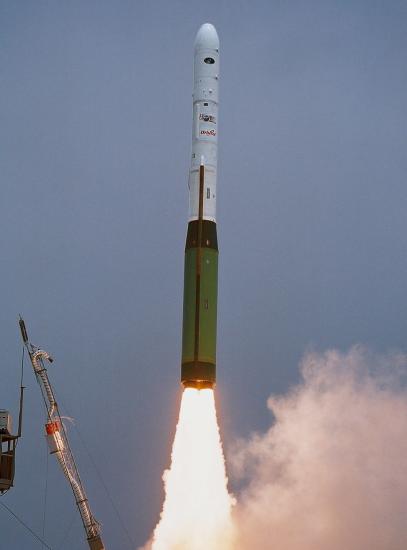 |
| Photo: Orbital Sciences |
| Minotaur I |
| Stage | Length | Diameter | Engine | Fuel | Thrust |
|---|---|---|---|---|---|
| 1 | 7.50 m | 1.70 m | 1 Thiokol TX55 | solid | 791,424 N |
| 2 | 4.10 m | 1.22 m | 1 Aerojet SR19 | solid | 267,730 N |
| 3 | 3.60 m | 1.22 m | 1 Alliant Techs. Orion 50XL | solid | 153,508 N |
| 4 | 2.10 m | 1.22 m | 1 Alliant Techs. Orion 38 | solid | 34,569 N |
Specifications for Minotaur I
A total of 12 orbital Minotaur I missions were flown between 27 January 2000 and 15 June 2021.
The Minotaur II was a suborbital rocket, which was used in 4 flights as a target vehicle for tests of the GBI interceptor missile in 2002.
Northrop Grumman Minotaur IV
Minotaur IV is completely different from the earlier Minotaur. The baseline version is a 4-stage vehicle, using the first three stages (SR118, SR119 and SR120 solid-rocket motors) of decommissioned LGM-118A Peacekeeper missiles, and an Orion 38 as 4th stage. There are several variations of this basic configuration:
- Minotaur III: 4th stage replaced by "Super-HAPS" (Hydrazine Auxiliary Propulsion System)
- Minotaur IV Lite: Suborbital vehicle, no 4th stage
- Minotaur IV HAPS: Hydrazine Auxiliary Propulsion System 5th stage
- Minotaur IV Orion 38: Orion 38 5th stage
- Minotaur IV+: 4th stage replaced by Star-48BV
- Minotaur V: Minotaur IV+ with Star-37FM 5th stage
- Minotaur VI: Minotaur IV+ with a second SR118 inserted between the SR118 und SR119
- Minotaur VI+: Minotaur VI with Star-37FM 6th stage
Of these, the III, VI and VI+ have never been built and flown.
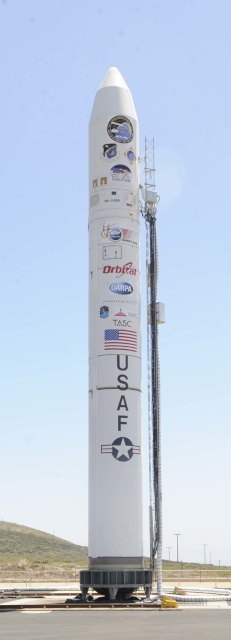 |
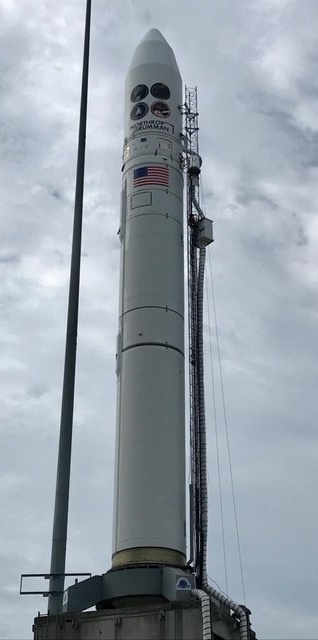 | |
| Photo: USAF/Staff Sgt. Scottie McCord | Photo: USAF/Lt.Col. Ryan Rose | |
| Minotaur IV Lite | Minotaur IV |
Because the surplus Peacekeeper rocket motors are Government Furnished Equipment, all Minotaur IV launches are for government entities, like the military or the National Reconnaissance Office. The first launch was a Minotaur IV Lite on 22 April 2010, sending the first HTV-2 test vehicle on a suborbital hypersonic trajectory. On the first orbital launch, a baseline Minotaur IV put the LS-15A SBSS (Space-Based Space Surveillance) satellite in orbit. By the end of 2025, a total of nine vehicles of the Minotaur IV family have flown, with seven of these being orbital launches. Since 2018, the prime contractor for Minotaur IV is Northrop Grumman, after having taken over Orbital ATK, which had been formed by merging Orbital Sciences and Alliant Techsystems.
Specifications
Note: Data given by several sources show slight variations. Figures given below may therefore be inaccurate!
Data for Minotaur IV:
| Length | 23.9 m (78.3 ft) |
| Diameter | 2.34 m (7 ft 8 in) |
| Weight | max at lift-off: 86300 kg (190300 lb) |
| Payload to LEO | 1735 kg (3825 lb) |
| Propulsion |
1st stage: Thiokol SR118 solid-fueled rocket; 2225 kN (500000 lb) 2nd stage: Aerojet SR119 solid-fueled rocket; 1225 kN (275000 lb) 3rd stage: Hercules SR120 solid-fueled rocket; 290 kN (65000 lb) 4th stage: Hercules/ATK Orion-38 solid-fueled rocket; 32.2 kN (7200 lb) |
Main Sources (for updates in 2026)
[1] Gunter Krebs: Gunter's Space Page
Back to Directory of U.S. Military Rockets and Missiles, Appendix 3
Last Updated: 19 February 2026