SpaceX Falcon
Falcon 1
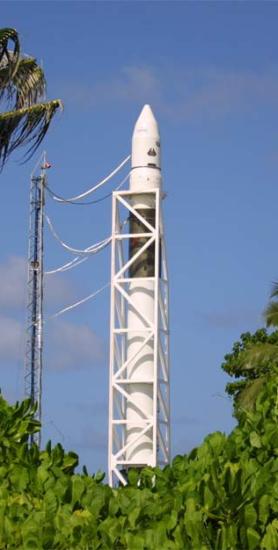
The Falcon 1 was developed by the then newly founded company Space Exploration Technologies Corp., commonly known as SpaceX, as a low-cost small space launch vehicle. It was a two-stage liquid-fueled rocket using a SpaceX Merlin (1st stage) and a SpaceX Kestrel (2nd stage) engine. Both engines burned liquid oxygen (LOX) and kerosene. The Falcon 1 was SpaceX's entry for the USAF/DARPA Falcon SLV (Small Launch Vehicle) program in the 2004/2005 timeframe. That program was eventually cancelled, though.
The first flight of a Falcon 1 test rocket, with a Merlin 1A first-stage engine, was first attempted on 27 November 2005. That launch attempt, as well as the next two on 19 December and 9 February, were aborted because of technical problems. Finally, the first launch occurred on 24 March, but the vehicle was lost due to a first-stage malfunction less than a minute after lift-off. The second and third flights also ended in failures. The fourth test flight on 28 September 2008 finally succeeded in reaching orbit, a first for a privately developed liquid-fueled launch vehicle. The fifth flight, on 14 July 2009, was also the final one of the Falcon 1. The last three flights all used an uprated Merlin 1C in the first stage.
 |
| Photo: SpaceX |
| Falcon 1 |
SpaceX originally had plans to develop the Falcon 1e, to be powered by an uprated Merlin 1D in a stretched first-stage. However, this version, and the whole Falcon 1 program, were cancelled when SpaceX fully concentrated on the Falcon 9. Also cancelled was the projected Falcon 5, a development with 5 Merlin engines in the first stage and a single Kestrel in the second stage.
Specifications
Note: Data given by several sources show slight variations. Figures given below may therefore be inaccurate!
Data for Falcon 1:
| Length | 22.3 m (73 ft) |
| Diameter | 1.7 m (5.6 ft) |
| Weight | max at lift-off: 33230 kg (73260 lb) |
| Payload to LEO | 470 kg (1040 lb) |
| Propulsion |
1st stage: 1 Merlin 1C liquid-fueled rocket; 343 kN (77000 lb) at lift-off 2nd stage: 1 Kestrel liquid-fueled rocket; 31 kN (7000 lb) |
Falcon 9
Soon after the Falcon 1 had flown, SpaceX began the development of Falcon 9, a two-stage medium-lift launch vehicle. The first stage uses 9 SpaceX Merlin engines, while the second stage uses a single Merlin, optimized for operation in a vacuum. The Merlin can be restarted repeatedly, so that the upper stage can deliver several payloads to different orbits.
 |
| Image: Avialuh, CC BY-SA 4.0 |
| Falcon 9 |
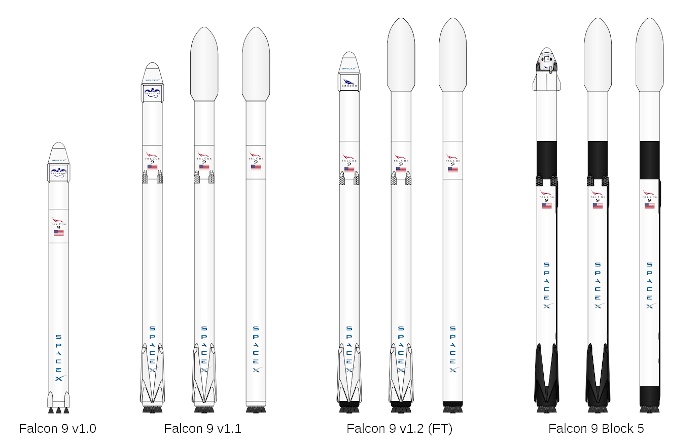
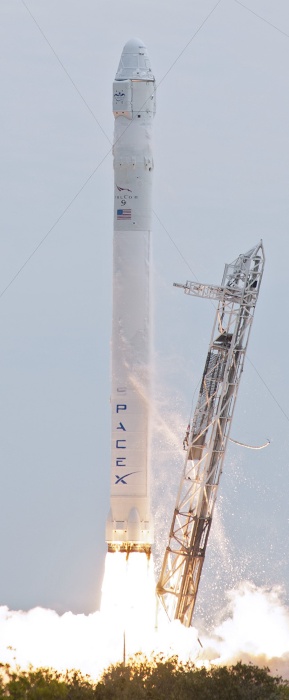
The initial Falcon 9 v1.0 version had the 9 first-stage Merlin 1C engines arranged in a square 3x3 pattern. The rocket was effectively a test and development design, and has flown only five times, between 4 June 2010 and 1 March 2013. All missions carried a SpaceX Dragon cargo delivery vehicle as payload.
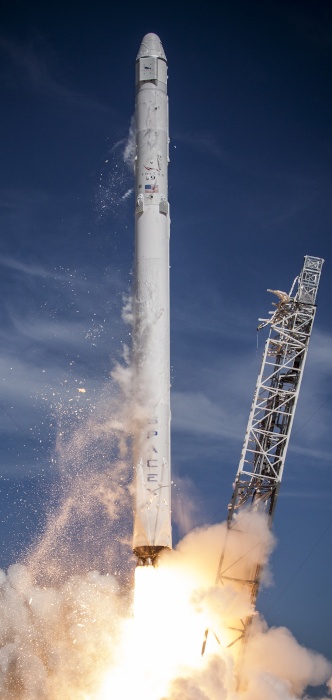
The next variant was the Falcon 9 v1.1. It had its first stage engines rearranged in an octagonal pattern plus a single center engine. The first stage was lengthened by about 60%, and the engines were of the significantly uprated Merlin 1D type. The payload section is either a Dragon vehicle, or a fairing of 5.2 m (17 ft) diameter housing the customer's orbital payload. With v1.1, SpaceX also initiated the development of reusable first stages. A reusable booster is fitted with four extensible landing legs, and movable grid fins at the top. After stage separation, the booster is reoriented for reentry, which is stabilized and controlled by the fins. Three engines fire to slow down the descent for a soft landing on the extended legs, typically on an unmanned barge at sea. Recovery of the booster reduces the maximum payload mass, because of the extra landing gear weight and because some fuel is needed for the controlled reentry and landing burns.
A total of 15 Falcon 9 v1.1 were launched, between 29 September 2013 and 21 January 2016. This included three attempts to recover the booster, none of which was fully successful.
| Stage | Length | Diameter | Engine(s) | Fuel | Thrust |
|---|---|---|---|---|---|
| 1 | 41.2 m | 3.66 m | 9 SpaceX Merlin 1D | LOX/kerosene | 654 kN each |
| 2 | 13.6 m | 3.66 m | 1 SpaceX Merlin 1D Vacuum | LOX/kerosene | 716 kN |
Specifications for Falcon 9 v1.1 stages
 |
 | |
| Photo: NASA | Photo: SpaceX | |
| Falcon 9 v1.0 | Falcon 9 v1.1 |
The v1.0 and v1.1 versions were interim steps towards the ultimate Falcon 9 v1.2 version, which is nowadays mostly referred to as Falcon 9 FT (Full Thrust). Major changes compared to v1.1 include subcooled oxidizer and fuel for increased propellant weight and engine thrust, a slightly larger second stage tank, and improved designs for the interstage, the grid fins and the landing legs. The first flight occurred on 22 December 2015, and was fully successful, including the soft landing of the booster.
The initial Falcon 9 FT was also known as Falcon 9 FT Block 3, and was succeeded by the Block 4 variant. The main difference was an incremental engine thrust upgrade. The current variant at the time of this writing is the Falcon 9 FT Block 5. It has further increased engine performance, and several changes to the landing and recovery system. In 2017, SpaceX introduced the option to also recover and reuse the two halves of the payload fairing.
| Stage | Length | Diameter | Engine(s) | Fuel | Thrust |
|---|---|---|---|---|---|
| 1 | 42.6 m | 3.66 m | 9 SpaceX Merlin 1D | LOX/kerosene | 845 kN each |
| 2 | 13.8 m | 3.66 m | 1 SpaceX Merlin 1D Vacuum | LOX/kerosene | 981 kN |
Specifications for Falcon 9 FT Block 5 stages
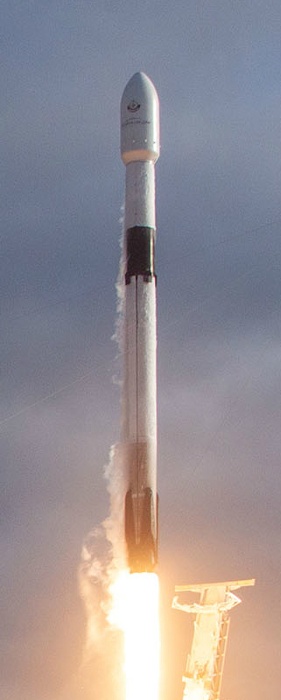
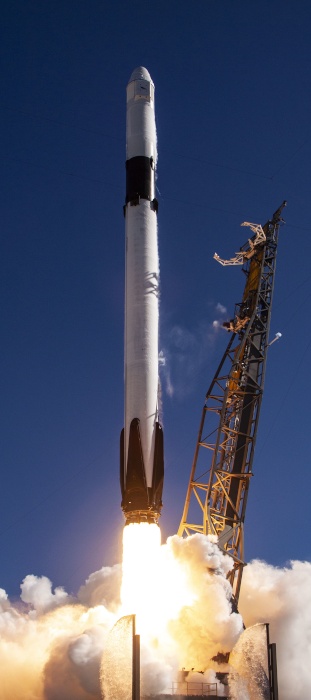
Falcon 9 FT Block 5, first launched on 11 May 2018, is SpaceX's "workhorse" launcher. It's partial reusabilty facilitates a high launch cadence, and by early 2026, more than 540 rockets of that type had flown, with very high reliability (success rate > 99%). A large part of the launches were for SpaceX's own Starlink mega-constellation, but the vehicle is also used for many defense-related missions by the U.S. Space Force and the National Reconnaissance Office. The Block 5 is also fully man-rated, and to date has launched 12 Crew Dragon spacecraft to the ISS.
 |
 | |
| Photos: SpaceX | ||
| Falcon 9 FT Block 5 (left: payload fairing, right: Dragon) | ||
Specifications
Note: Data given by several sources show slight variations. Figures given below may therefore be inaccurate!
Data for Falcon 9 v1.0, v1.1, FT Block 5:
| v1.0 | v1.1 | |
|---|---|---|
| Length | max: 54.9 m (180 ft) | max: 68.4 m (224 ft) |
| Diameter | 3.66 m (12 ft) | 3.66 m (12 ft) Payload fairing: 5.2 m (17 ft) |
| Weight | max at lift-off: 333 t (735000 lb) | 506 t (1115200 lb) |
| Payload to LEO | 9000 kg (20000 lb) | 10900 kg (24000 lb) |
| Payload to GTO | 3400 kg (7500 lb) | 4850 kg (10690 lb) |
| Propulsion |
1st stage: 9 Merlin 1C; 4940 kN (1110000 lb) at lift-off 2nd stage: 1 Merlin 1C Vacuum; 445 kN (100000 lb) |
1st stage: 9 Merlin 1D; 5885 kN (1323000 lb) at lift-off 2nd stage: 1 Merlin 1D Vacuum; 716 kN (161000 lb) |
| FT Block 5 | |
|---|---|
| Length | max: 70 m (230 ft) |
| Diameter | Stage 1 & 2: 3.66 m (12 ft) Payload fairing: 5.2 m (17 ft) |
| Weight | max at lift-off: 549 t (1208000 lb) |
| Payload to LEO | expendable: 22800 kg (50300 lb) reusable: > 17400 kg (38400 lb) |
| Payload to GTO | expendable: 8300 kg (18300 lb) reusable: > 5800 kg (11700 lb) |
| Propulsion |
1st stage: 9 Merlin 1D liquid-fueled rockets; 7605 kN (1709000 lb) at lift-off 2nd stage: 1 Merlin 1D Vacuum liquid-fueled rocket; 981 kN (220500 lb) |
Falcon Heavy
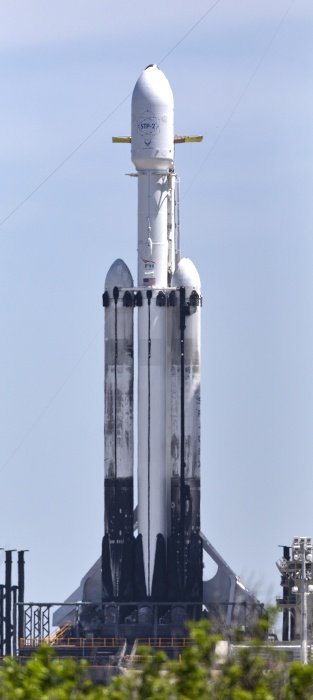
Falcon Heavy is a heavy-lift launch vehicle, which consists of three Falcon 9 booster stages as first stage, and the same second stage as the Falcon 9.
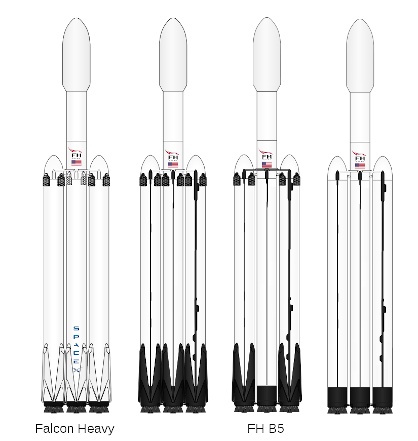 |
| Image: Avialuh, CC BY-SA 4.0 |
| Falcon Heavy |
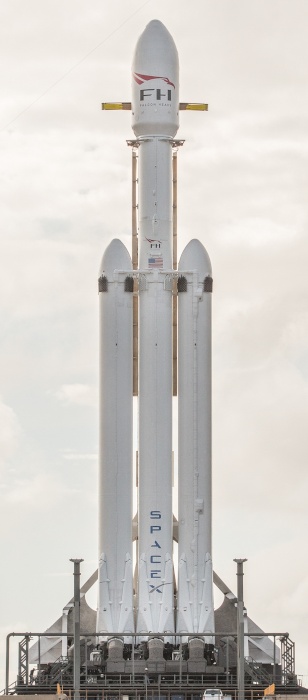
Development of the Falcon Heavy took longer than expected, and the first flight, originally planned for the early 2010s, eventually occurred on 6 February 2018. The rocket can be configured for three different levels of reusability: reuse all three booster cores, only the two outer ones, or none. By early 2026, eleven Falcon Heavy missions have been flown, all successfully. SpaceX has contracts for at least two addtional NRO and six additional USSF Falcon Heavy flights.
 |
 | |
| Photo: Kim Shiflett, NASA | Photo: SpaceX | |
| Falcon Heavy | ||
| Stage | Length | Diameter | Engine(s) | Fuel | Thrust |
|---|---|---|---|---|---|
| 1 | 42.6 m | 12.2 m (width) | 27 SpaceX Merlin 1D | LOX/kerosene | 845 kN each |
| 2 | 13.8 m | 3.66 m | 1 SpaceX Merlin 1D Vacuum | LOX/kerosene | 981 kN |
Specifications for Falcon Heavy stages
Specifications
Note: Data given by several sources show slight variations. Figures given below may therefore be inaccurate!
Data for Falcon Heavy:
| Length | max: 70 m (230 ft) |
| Width / Diameter | Stage 1 (width): 12.2 m (39.9 ft) Stage 2 (diameter): 3.66 m (12 ft) Payload fairing (diameter): 5.2 m (17 ft) |
| Weight | max at lift-off: 1421 t (3125000 lb) |
| Payload to LEO | expendable: 63800 kg (140660 lb) fully reusable: ca. 57000 kg (126000 lb) |
| Payload to GTO | expendable: 26700 kg (58860 lb) fully reusable: > 8000 kg (17600 lb) |
| Propulsion |
1st stage: 27 Merlin 1D liquid-fueled rockets; 22819 kN (5130000 lb) at lift-off 2nd stage: 1 Merlin 1D Vacuum liquid-fueled rocket; 981 kN (220500 lb) |
Main Sources
[1] SpaceX Website: Falcon 9
[2] SpaceX Website: Falcon Heavy
[3] Michael H. Gorn, Giuseppe de Chiara, Davide Sivolella: "The Complete Book of Spacecraft", 2nd ed., Motorbooks, 2025
[4] Gunter Krebs: Gunter's Space Page (for launch lists)
Back to Directory of U.S. Military Rockets and Missiles, Appendix 3
Last Updated: 18 February 2026